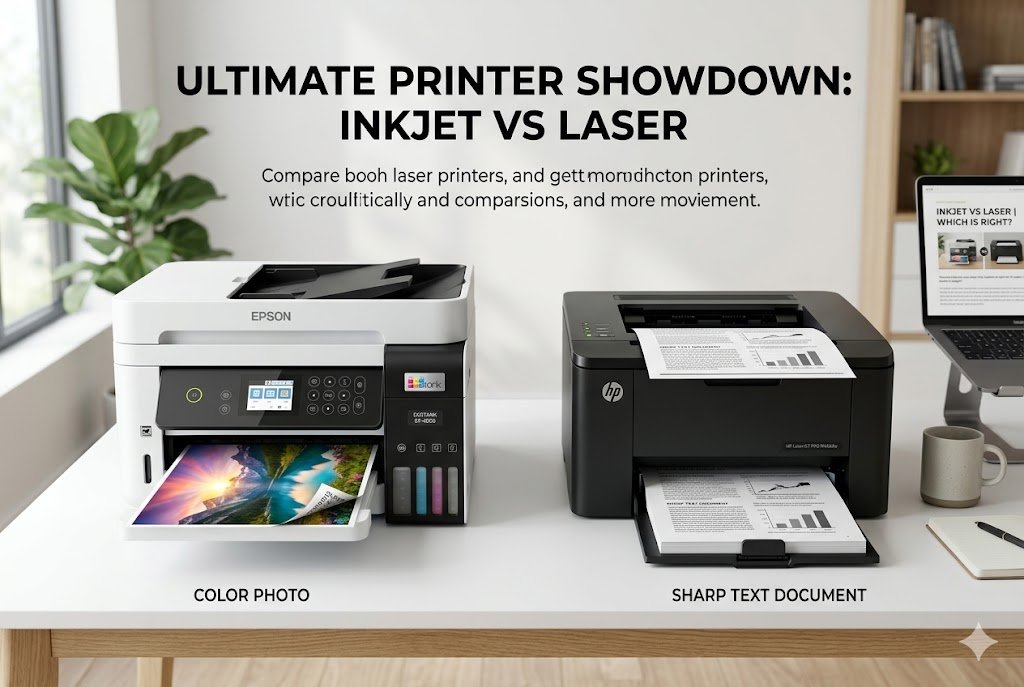
Inkjet or laser? It is the most frequently asked printer question, and the correct answer depends entirely on how you print. There is no universal winner — each technology has distinct strengths that make it the right choice for specific use cases and print volumes. This guide breaks down every meaningful difference so you can make the right decision for your situation.
How They Work
Inkjet printers work by spraying microscopic droplets of liquid ink through tiny nozzles onto paper. The nozzles can apply ink with extraordinary precision, which is why inkjets produce superior photo and color output. The downside is that liquid ink is expensive to produce and expensive to buy in cartridge form.
Laser printers use a different process entirely. A laser beam draws the image onto a photosensitive drum, which attracts powdered toner. The toner is then transferred to paper and fused permanently with heat. The result is faster printing, smudge-proof output, and a dramatically lower cost per page — especially for black and white documents.
Print Quality Comparison
For photo printing and color graphics, inkjets win without contest. Modern inkjet printers can produce photos indistinguishable from lab prints on the right paper, with smooth gradients, accurate skin tones, and detail in shadow areas. Laser printers produce noticeably inferior photo output — colors appear slightly flat, and gradients can show banding on close inspection.
For text and office documents, laser printers produce crisper, more consistent output. The toner is fused to the paper rather than absorbed into it, resulting in sharper edges on letters and no risk of smudging when wet. For everyday document printing, the difference is minor, but at very small font sizes, a laser printer's edge is visible.
Inkjet — Print Quality Strengths
- Superior photo and color output
- Smooth gradients and fine detail
- Prints on a wide range of media
- Better for graphics and presentations
Laser — Print Quality Strengths
- Crisper text at all sizes
- Smudge-proof, water-resistant output
- Consistent quality across large print runs
- No print head clogging issues
Cost Comparison: Upfront vs. Running Costs
Inkjet printers have a lower entry price — a capable all-in-one inkjet starts around $100 to $150. However, replacement cartridges are expensive relative to the ink volume they contain. A standard inkjet cartridge might yield 250 pages at a cost of $15 to $20, putting the cost per page at $0.06 to $0.08 for color. For light users, this is acceptable. For anyone printing more than 150 pages per month, the running costs become significant.
Laser printers cost more upfront — a good monochrome laser starts around $200 and a color laser around $350. But toner cartridges last 1,500 to 5,000 pages and cost $30 to $60, reducing the cost per black page to $0.015 to $0.02 and color to $0.04 to $0.06. The breakeven point for a laser over an inkjet is typically reached within 6 to 12 months for users printing 200+ pages per month.
Print Speed
Laser printers are faster, and the gap is most visible when printing large documents. A typical laser printer produces 30 to 40 pages per minute for black text. A typical inkjet manages 10 to 20 pages per minute. More importantly, laser printers produce the first page faster once warmed up and maintain speed consistently across long print runs without the slowdowns inkjets can experience on dense pages.
Which Should You Buy?
Choose an inkjet if you print photos regularly, print occasional color documents, print in low volumes (fewer than 100 pages per month), or need to print on specialty media such as photo paper, card stock, or fabric transfer sheets. The Epson EcoTank series dramatically reduces inkjet running costs and is worth considering for moderate-volume home users.
Choose a laser printer if you primarily print black and white documents, print in high volumes (200+ pages per month), need fast output with consistent quality, or want a printer that remains reliable even after weeks of sitting unused. Laser printers do not suffer from dried ink nozzles — a common inkjet failure mode for infrequent users.